We left Vitoria for Pamplona. However, on the way we go to Bilbao to see the Guggenheim Museum and San Sebastian for lunch.
Scenery has changed a lot. It is very green with mountains either side of the highway covered in distinctively different shades of green. It is very hard to describe and photograph in the bus. Spring has sprung.
Samuel gave us a big history lesson this morning – far too much to get written down with a lot of accuracy but I did get that Christopher Columbus was very important to Spain even though he was not Spanish. He managed to convince the Catholic monarchs to give him three boats to set sail and find a new route to India to avoid the Ottomans. It took him three and half months to find a new land but it was not India. It was called West Indies. Anyway this was very important and strategically successful for Spain.
1808 Napoleon invaded Spain on his way to get to Portugal which he also took over. 1813 Spain got their act together and took five years to get rid of the French. Whilst the French ruled Spain Joseph Bonaparte was the King of Spain and apparently was very progressive but the Spanish hated him and he finally left. The Spanish King was reinstated Fernando 7th who was a terrible king and during his 20 year reign the country went backwards.
1898 there was the war of Cuba between American and the Spanish and it was the end of the Spanish empire. They lost Cuba, Puerto Rico, Guam and the Philippines. Guam was very important strategically because of the naval base. However, later on America helped the Spanish with money. I think Eisenhower had something to do with it.
He talked more about Franco who had concentration camps. Woman were not allowed to work after they were married and could only have a bank account if it was authorized by their husband, father or brother. Franco hated everyone. He died in 1975. The only good thing he did.
So our history lesson comes to an end as we drive into Bilbao to see the Guggenheim Museum designed by Frank Gehry. Bilbao has a population of about 400,000 and was a great industrial city. Now, however, it is mainly tourism that the town relies on.
The museum is covered in titanium plates. It is fantastic. It opened in 1997 and the design of the building is a big part of the museum itself not just its’ contents. There are curves, angles and viewing portals throughout the building giving views both within the building and outside landscape. It is bright, spacious and has a lot of height which lets in the natural light from the gorgeous surroundings. We were allowed to photograph in the entrance but not within the galleries.
We looked at some modern abstract expressionist paintings by Jackson Pollock and Mark Rothko. I am starting to worry about Ken as he understood the meaning of the painting by Pollock titled Male & Female.
We moved onto the late 1950’s 60’s to look at Andy Wharhol and others. It was all very impressive and once again Ken got the drift of the one showing multiple images of Marilyn Monroe. The guide rattled off things like celebrity, mask like, what was behind the creation of celebrity, the celebrity is the brand. These artists felt they had moved on from the abstract but in fact it was a progression from abstract onto how media was affecting our lives.
Next was the sculpture hall that contained huge rusting steel sculptures. They were made in Germany and it was bent cold. It took six weeks to do the installation. These were by Richard Serra. We were not allowed to take any photos so you will have to google this one.

Groovy bridge near by

The Structure

Tulips

Balls

Spider???

Incorporated bridge

What photography

Love the shape

Curves everywhere

Glimpses of design

Lost for words
Then we were off to San Sebastian. It has the most expensive real estate in Spain at $10,000 a square metre. It is very picturesque seaside town and very close to France. Unfortunately, for us it was raining today. This did not stop us from enjoying Jinxtos for lunch. This is like tapas but better and a little more substantial. The plates of food are placed on the counter and you pick what you are going to have and they warm it up if necessary. The idea is that you can go from bar to bar and have different Jinxtos, a drink and a friendly chat. This is not what we have been having in Barcelona or Madrid and is more what I expected tapas to be. Then off to have a pastry and a coffee at a shop recommended by Samuel, our guide.
Apparently a lot of Michelin star chefs train here in what they call the Basque country. There are three Michelin star restaurants here in San Sebastian. They have Food Society’s here that only allow men as members. They go off and do the grocery shopping, the cooking and the cleaning up. I wish these would come to Toowoomba. The men love to cook here.

Drouling

Chooses

Eggs how you have never had them before

Stuffed peppers

More to chose from

Yes we had Sea Urchin
We are back on the bus to go to Pamplona. Samuel was telling us that the Spanish are very touchy feely. It is accepted that when he is greeting male and female friends that he kisses them left and right cheek. Ken is worried about this practice making its way into Australian culture. Maybe there will be lots of hugging and kissing at the fishing competition this year!!!
On the way to Pamplona Samuel explains a lot about the bull fighting to us. There six bulls, three matadors and two oxen. The bulls are specially bred and weigh between 500-800 kgs. They cost between 10000 and 12000 euros and are about five years old. They are not exposed to humans so when they are in the ring they should go for the man and not the cape. The bulls are selected by ballot. The three matadors have a different amount of experience and if a junior matador is injured the senior matador takes over. There are three stages to the fight. Firstly, the footmen work the bull to tire him. While they are doing this the matador is checking the bull out for any physical weaknesses etc. If the bull is not feisty and wanting to fight he is replaced. They have six spare bulls for this. The oxen are used if the bull needs to be taken backstage. Apparently, the bull will follow the oxen readily. I think the next stage is when the Picador plunges the spear into the bull’s neck to make the bull lower its head. The final stage is when the matador takes on the bull. He does 40 passes to get the bull to come closer and closer to his body all the time with the bull getting weaker. The crowd should only go OLAY if it is a good pass. The bull is not always killed by the matador and is sometimes spared if he is judged to be courageous. If this happens the bull is treated with antibiotics and is retired for breeding. However, if the bull is killed it is taken to the local butcher and the people line up the next day to buy the meat especially the tail for soup. The meat is quite tough because the muscles are so stressed.
Some suggested reading by our guide is Ernest Hemmingway’s For Whom the Bell Tolls and Death in the Afternoon.
We arrive in Pamplona and quickly check into our hotel before we are taken to walk the famous streets where they have the running of the bulls on 7 July every year for a week. It is a nonstop party with people coming from all over the world to watch. The cost of a hotel room goes up to 600 or 700 euro a night and people who own apartments along the route charge 2000 euro for people to watch from them. It is 800m long and they put up wooden fences every morning of the seven days that is it run. It only takes two or three minutes. There are 12 bulls and two oxen and these are the ones that will be in the ring that afternoon. The problem is that people want to run with them. They must dress in white with a red scarf.
One of the most successful bull fighters earns 500000 euro per fight and he only does three a year. If I were I were him I would be retiring before the bull wins which he will do sooner or later. The Bull Fighter’s outfit costs 6000 euro. The Bull Fighter gets the tail if he wins. Bullfighters are paid on performance – how many tails he gets.
PS Ken is not going to take up bull fighting – no matter how much they get paid. (However I do like the cape, the pants on the other hand are a little tight. KD)

Who put this here in Pampalona

Town Hall Square where the bulls run

Sign post commemorating those hoiw have died under the bulls

Up through here and left turn

Sign to tell the bulls where to go

Up this alleyway

Right turn on cobble stones

And into the ring

The Running of the bulls in bronze

Hemmingway’s favourite motel

Town Square

The way of the shell

Also the way of the shell

Eddible foot wear??


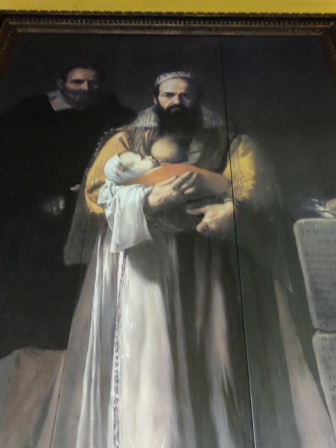


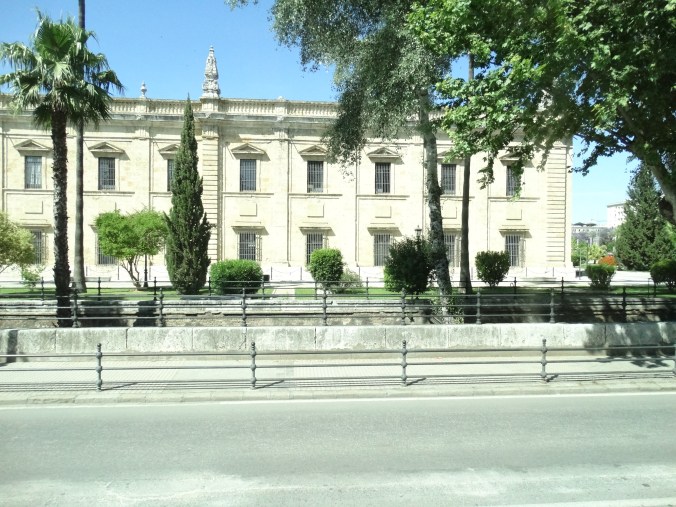 Carmen’s tobacco factory


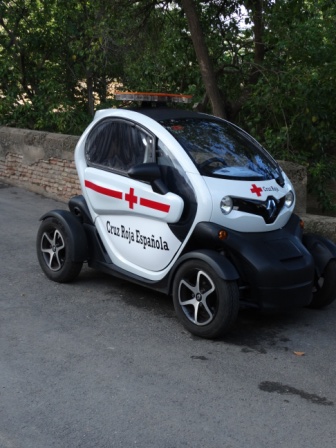 Ambulance hope they don’t want a stretcher


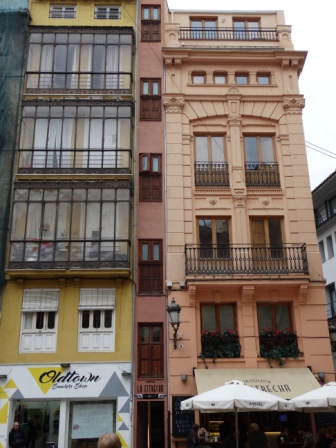


 Ken & Louise Dudley