May 3rd

We spend the day in Seville.

First stop the bull ring Plaza de Toros which is privately owned and has a capacity of 20000 people.  Tickets cost between 25 euro and 150 euro depending whether you want a seat in the shade.  This building was originally a military academy for nobleman to learn how to joust on horseback.  It was 1830 when the first bull fighting school opened.  We leant a little more regarding the trophies.  Apparently, the matador gets either one ear, two ears or the ears and the tail depending on what the crowd thinks (using white hankerchief) with the President having the final say.  If you are successful on the day and have three trophies you get carried out on the shoulders of the crowd. We had a look at the bull ring which they were preparing for the bull fight that night.  It has special soil that doesn’t create dust and Ken reckons doesn’t show the blood.

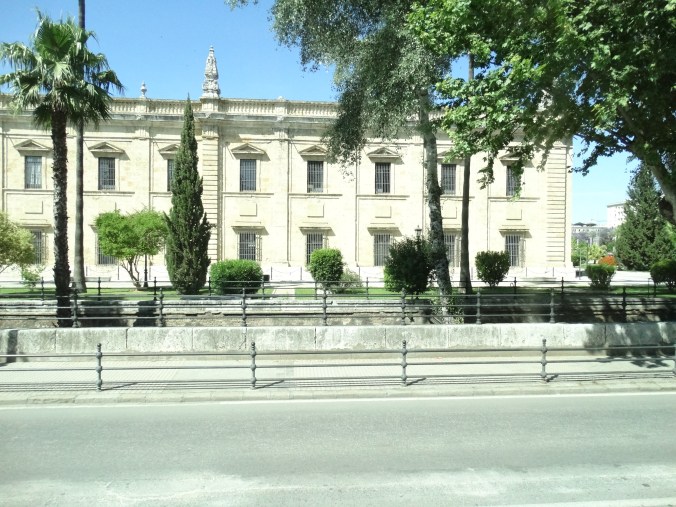
Next we have a drive around town.  We saw the building that is now a university that used to be the tobacco factory of Carmen fame. Seville was founded 2000 years ago.  Julius Caesar build first wall in 65BC.  We had a guided walk through Casa De Pilatos which had a mixture of Moorish and Roman architecture.  A noble family still live in part of the palace.  It has a cross on the front door which is the first station of cross in Holy week.  This palace was built by a noble family on land gained from the Inquisition.  There is a staircase that is quite unusual dome above it.  It is popular for daughters of noble families to have their debut here.  Caroline Kennedy had hers here.  A bit strange if you ask me.  Isn’t America good enough??  The tiles on the walls were amazing.  There were 150 different designs and more than 500000 tiles.


We then walked through the narrow streets of the Santa Cruz Quarter and onto another Cathedral St Mary of the Sea??  It is built on top of a mosque.  In 1248 the Christians did not destroy it but used it as a cathedral.  1356 there was an earthquake and a gothic style cathedral was built to replace the mosque.  It took 500 years to complete and because of this has a few different styles in it. The courtyard is where the Muslims cleaned themselves before praying.  The bell tower is 193 metres high but interestingly the top part is Christian and the bottom three quarters is from the Muslim era.  The earthquake that destroyed the mosque also caused the top of the tower to fall down and it was rebuilt by the Christians.  It has 25 bells and no stairs just ramps that was the bell ringer used a donkey to get up and down from.  The church cover 23500 square metres, has five naves and 44 chapels.  These were private chapels and the rich families paid for them.  It is said to be the largest cathedral in the world.  The alter is 24m high and 18m wide and has more than a 1000 statues in it to tell the story of Jesus.  They still have mass every day here.  One can only marry here is you are a royal or from a noble family. The organ which is 18th century had 7500 pipes the longest being 10 metres.  It is now computer controlled with one person operating it but prior to this is took 81 people to enable it to be played. A lot of people needed to pump the bellows.  It is the resting place of Christopher Columbus even though it is claimed only about 4 ounces remains.  He died in 1506 in Spain at the age of 55.  Columbus was buried five times.  Firstly, where he died, then Seville for 27 years, then in Demark where his son lived until 1795, then Cuba until 1898 and then back to Seville in the Cathedral.  In 2006 DNA was used to verify the remains were his.  This was able to be done as his brother and son were buried at the cathedral and the USA and Germany also helped to authenticate the findings.  The cathedral houses the largest Murillo painting.  There was an interesting story that the bottom right hand corner had been cut out of it and stolen.  This part of the picture showed the saint.  It was found six months later in New York in an antique shop.  It was returned and it is very evident where it has been placed back into the painting.

Tonight we went to a Flamenco show.  It was okay but a little commercial and we were rushed through the meal etc ready for the next show at 9.00.


DSC00125

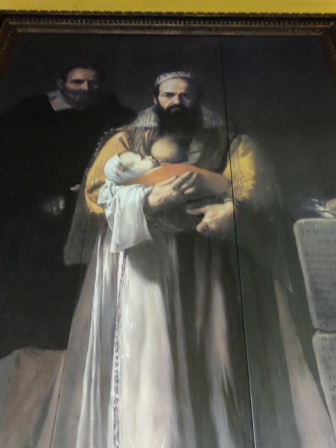
If my wife was this ugly I would not have a painting of her to remind everyone


May 2nd

Today we travel to Sevilla and the way to go to Gilbraltar.

Gilbraltar is a tax haven for 30000 companies.  England took over Gibraltar in 1704.  The average income is 62000 euro after tax and this is only 6% unemployment.  There is lot of building going on here.  It is only 23kms to the African coast.  Ten thousand people come from Spain everyday to work in Gilbraltar. There are 267 cruise ships a year stopping here which makes the tourist attrations and the town centre very crowded.  The island is 6.50 sq kilometres big.  Out from Euopa Point is where the Mediterranean and the Atlantic oceans meet.  They get their power from 30000lb diesel per day.  There are 55 kilometres of tunnels and only 30 kilometres of roads in Gibraltar.  Apart from Gibraltar being a tax haven tourism is big, tobacco smuggling and is head office for many on line gambling companies.  It also has a very busy port.  The big ships like to refuel, change their staff and replenish supplies here as it more reliable than alternative ports in the region.

We had to change to a smaller bus as we were once again going on a narrow windy road up the side showed off quite a lot.  Our bus driver had an interesting background.  He was Polish who had worked in Ireland, five years driving London buses and now in Gibraltar but he lives in Spain.  There are 300 apes on the Rock and they are fed twice a day.  I’ve never seen Ken move so quick as when he thought one of them was going to join him in the bus.  It is not sure how they came to the Rock initially.

We then drove on to Seville.  It has a population of 100000 and 10000 orange trees that are mainly for decoration and shade in the summer.  The oranges are a form of bitter orange that you can’t eat, rather they are sent to England for marmalade and France to make Contreau, cosmetics and perfumes. The river does go right to the ocean.

We went for a walk to an amazing square.  It was fortunately the week they were celebrating Real de la Feria which is like our Royal Shows on party steroids.  It started out as a big cattle sale and it turned in a weeklong festival of people having a lot of fun.  The women dress in traditional dress and the men also dress nicely in suits.  They have horse drawn and mule drawn carriages to take you to la Feria.  The more horses the flasher, the people and the carriage. The cheap ones use mules or donkeys; they are the ones with the big ears. There was 450000 sq metres of area dedicated to tents (Casetas) that are decorated with lights, have music and food for private patrons and there is the occasional one that the public can go into.  There are over 1000 Casetas of which there are only seven public Casetas. I tried to find a Rotary one but gave up. The music they play and dance to is Savillanas, a local genre of music. They dance a form of flamenco without the stomping.  Louise danced with one of the men on our trip and then Louise and I danced an amazing Cha Cha Cha.   Well it was amazing in my mind although I think the locals weren’t impressed.


DSC09952Carmen’s tobacco factory

April 30th

Today we leave Granada for Costa Del Sol on the sunny coast as they say here.

A little way out of Granada we visit the Alhambra which is the most visited place in Spain.  They allow 8000 people  per day to visit and it is  spectacular.  We have a four hour guided visit here.

The Alhambra(with silent H) was where the Muslims lived from 7 – 14th century.  Arabic life was not viewed from the outside.  We had to go inside the walls.

The Muslims did not think anything existed past this point and that the world ended with Spain.

The walls are covered in beautiful glazed tiles and the intricate walls are made from stucco moulds using water, plaster, alabaster and marble powder and plaster is used to attach them to the cornices and walls.  Originally these were then painted with colours such as blue, red and gold.  Some areas we saw had a faint blue still showing.  The ceilings are cedar wood.

Throne room was the most important room.  The Sultan received ambassadors and other important people here.  He sat in front of the light and could see his visitor clearly which gave him the advantage.

The walls were covered in the Koran, poems and stories of battles.  One particular on was repeated regularly.  It is read right to left and says “There is no conqueror but God”.

It was here that Queen Isabella gave Columbus the documents that enabled him to travel to find America.  It was joked by both our guides that this was the first traveller’s cheque written.

We visited the private rooms of the Sultan and the harem. The private rooms had the most beautiful ceilings in the Alhambra.  There is a very important painting on the ceiling that they cannot work out how to restore as it is done on leather.

The Sultan was allowed four wives and as many concubines as they wanted. Just one was the Sultana and that was the first wife to give him a boy child.

We walked through the bathes, the medina, the Summer Palace and the most amazing gardens.  The Summer Palace was outside the Alhambra and we walked through the Paradise Gardens. The Summer Palace was just for relaxing no work done here.

We then left the Alhambra to finish our journey to Costa Del Sol.

This is an important area for growing olives. There are 24 million trees and 60% of world’s requirement of olive oil is produced by Spain.  Olives were introduced by the Greeks originally.  Twenty five percent is produced here in Andalucía. The Arabs refined the process to get the most oil out of the olives.  They take 5 – 10 years to bear fruit and continue to produce fruit for up to 150 years of age. It is a bi-annual crop with one year producing 25kgs per tree and the other year 50kgs.  It is a crop that requires irrigation with the trees being watered every 10 days.

Malaga is near Costa del Sol and it where Picasso was born.  It has a very busy airport with flights going everywhere in Europe.

We arrive in Costa del Sol and I must say even though it sounds exotic it is nowhere near as gorgeous as our sunny coast.  Once again the beach is comprised of dark sand come rock.  There are no tides and no waves.  The water was still very cold even though the temperature was quite hot.  We visited Mijas up in the hills from Costa del Sol in the afternoon.  It was a picturesque town where all of the houses have to be painted white.  There are red geraniums potted in blue pots against the while walls. Donkey power is popular here.  We had a nice dinner out where we tried fried anchovies and other tapas dishes, sea bass baked in salt and dessert.

The next day was a free day for us so we found our way up into another part of the town to do our laundry.  While we waited for the washing and drying to be done we enjoyed two glasses of wine, three beers and three lots of tapas for 10 euro.  The Laundromat cost 8 euro. Good value I think??  We had freshly caught sea bass cooked on a sword over coals for dinner.

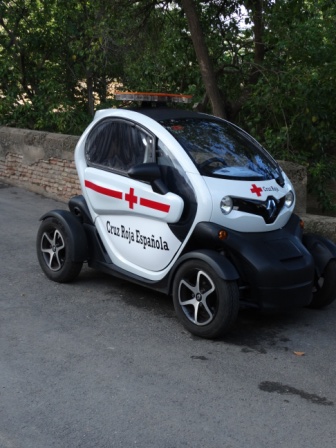
DSC09461Ambulance  hope they don’t want a stretcher


April 29th

We have a big trip today to Granada 540 kilometres away.

Samuel talked to us about their Christmas traditions.  Everyone has 12 days off including the children from school.

It sounds a bit like ours with lots of food and competition between mother’s and mother in laws to see who can feed the family the most each year.  They have the main meal Christmas eve.  It comprise of canapés, fish soup, turkey, a pineapple dessert and Christmas cake. They then go to church at 12.00.  Historically gifts were given on the 5th and 6th January but now the kids usually get their presents on Christmas Eve so they have time to play with them before they go back to school.  They have Christmas sales on 7th January and then everyone goes back to work and school.  Boxing Day is not significant here.

During the drive we see crops of lettuce and cucumber which they export but there is also broccoli, cauliflower, artichokes, pomegranates and more almond and citrus trees.

He talked about weddings and that divorce only legal since 1982.

We arrive in Granada safely.

We go on a guided walk/bus tour and learn a lot more about Granada.  We visited a Carthuscien Monastery which was small but incredible. Not many photos as ran out of battery. We also visited the cathedral of course.  This one is famous because Queen Isabella and King Fernand are buried here.  It was to be a simple chapel but it was not finished when they died.  It ended up like all of the others which was very impressive.  The Carrara marble was used in the monuments to Isabella.  The alter had so many figures on it.  The figures told the biblical story of Jesus.  This meant that the people who could not read which was most of the population could learn about Jesus.  There is still a service at 9.30 every day.  Queen Isabella’s crown and King Fernand’s sword were there as well as works of art by Flemish, Italian and Spanish masters from 15th century.

The big industry for Granada is the university with 60000 students attending the uni with most of them coming from outside Granada.  The economy is not in good shape here and there is over 30% unemployment.  They do have some factories for milk products, olive oil and a brewery.

We had dinner out and it was excellent. Tapas of tuna salad, tasty lemony fish bits, jamon and tomato on toast(usual recipe) and tempura eggplant. Ken had pork ribs and I had ratatouille with a runny egg on top and finished off with delicious cake topped with chocolate. Red wine of course accompanied the meal.

April 28th

The bus turned up.  We all hoped for the best.  Everything was fine.

Today we go to Valencia.  We travel down the coast road and the houses look more like Spanish haciendas and it is lot drier looking.  There are mountains close to the coast.

Samuel told a lot of history on the Spanish Inquisition.  If anyone wants to know about this please let me know.

There are 8 nuclear power plants and they provide 20% of the power and 40% is from coal, gas and oil and the rest is from solar and wind.  They sometimes have to import power from France.

You can drink alcohol, vote and drive when you are 18.

Spanish people do not camp much but people from France and the Netherlands like to especially in the area that we were driving through.

Valencia has about 1000000 people and is the third largest city.  Main industry is furniture, ceramics and flowers.  They grow 40% of Europe’s needs.  We went to the city of Arts and Sciences again.  These buildings were designed by Calatrava .  There are still three bull fights a year here.

During our guided walk we had a drink made from tiger nuts(from a tree) and is called horchata.  It is made with sugar and water and served cold.  It was quite refreshing. It cured high blood pressure, cholesterol,  fertility, heart, liver anti oxidant etc.  In other words it cures everything Ken has.

City of Arts and Sciences


Alabaster clad house with one figure in pain

Smallest house in Europe (the one in the middle)

DSC09296

Gates of old city wall

April 27th

Up early again to visit Montserrat. Unfortunately for the rest of the people on the bus it was like a typical Toowoomba winter’s day at 0 degrees and fog thick as.  Montserrat is 3000 feet above sea level and the road is very windy. We slept most of the way up because we are exhausted.  When we got up there you could not see anything as the fog had closed in.  We had a coffee and I bought a bottled of the Monk’s special brew.

Louise had a bright idea with 25 minutes to go and touch the Black Madonna.  We got in line and it moved very slowly and at some point we knew were not going to make the bus.  We pushed back through the line only to find the gate locked behind us so people wouldn’t be looking at the Madonna while the 11.00 service was on. We then moved forward only to find the only way out was over a balustrade in front of the whole congregation.  Lou was prepare for the high jump and I was worried dickie knee. Fortunately a monk came along with a key and let us out to make a hasty retreat through the congregation.

On the way back to Barcelona the bus was making a funny beeping noise and as I wasn’t the driver I wasn’t worried until the bus stopped in the middle of peak hour in Barcelona. Our tour guide taught the bus driver how to Face Time with the Volvo mechanic and after about half an hour we walked to the motel.  An hour later the bus turned up for our afternoon tour.  We got about 400m before the bus refused to move again.  A few quick calls and a new bus pulled up behind us and we were off for the afternoon trip to around Barcelona and to go to Sagrada Familia Bascilica.  It was now raining and cold.

This church, still in construction, was started 160 years ago. The first architect was fired so they set out to find a new architect.  The requirements were that they were catholic, religious and wouldn’t charge.  Well Gaudi fitted requirements and he took on the job of designing the church.  He lived in a brick building beside the church and all the money that he earnt from his private commissions he gave to the Catholic Church. The columns of the church were based on nature ie. trees and he preformed all the calculations to ensure the columns and the tree like structures were sufficient to hold the roof. 85% of the money to build the church is from admission charges and the other 15% is from people who want to pay their way into heaven by paying for forgiveness for their sins.

The colours of the stain glass windows go from the cool colours of dawn to the golden colours of the evenings as they move from east to west.  There is not stain glass windows of the saints because this church is about the family of Christ; Mary and Joseph. Interesting Gaudi included white stained glass for the first time in a window.  The door, struck in bronze, has the Lords Payer in Catalan and in 59 other languages.  The door handles are A and G. The church is designed to hold 6500 people.  In the civil war of Spain the plans of Gaudi were destroyed and luckily there were photographs of his plans that other architects were able to redraw his ideas.

The figure of Christ on the cross was the first to show him in agony and in the throws of death. This sculpture was also under an umbrella made by Gaudi.

There are 52 columns to represent the 52 weeks of the year and around the alter there are 12 columns to represent the 12 apostles.  The entrance doors are made by a Japanese architect and they have many of the insects of the worlds on a leaf pattern.  The fonts at the entrance are made from shells donated by the people of the Philippines.

One side is the nativity side and is more joyous whereas on the passion side the sculptures are more cubist and severe.

Gaudi lived like a hermit and when a tram ran him over the driver got out and put him to one side as he thought he was a homeless person.  He was taken to hospital and died a few days later and he is buried in a crypt at the Sagrada Familia.

We got taxis back to the hotel as the bus we found out got a batch diesel with some water in it.

We went to the beach front to have dinner.  The Tapas was good and then we tried the suckling pig.  We think it was more like a teenager or older.  The dessert was lovely. Creme caramel and a traditional almond slice.

April 26th

This morning is an early start at 7.30 and it is very cold.  Today we drive to Barcelona.

Samuel once again gives a talk and today it is on the education and health system.

It is compulsory to go to school from the age of 6 – 16. No home schooling is allowed.

After senior you can do two year bachelor course which is very difficult and then you go to university and do four years. However, medicine and architecture are six years.  University education is free/no student loans. Generally one goes to the closest university.  If you have to travel you rent during the week, catch a train home on Friday and return on Sunday with prepared meals from Mum and Grandma to get you through the week.  Apparently Tupperware is very big over here for that reason.

You do pay for books which is about 600 – 1000 euro per year.

Sport is not encouraged and there are no sporting scholarships.  There are scholarships available for those whose parents are unemployed or just cannot afford to send their children to university.  However, these students have to do better than a pass to remain in uni. –

A masters degree costs between 6000 – 60000 euro depending on the course.  Phd takes five years and you go onto to be a professor. A high school teacher needs to have a specialist degree plus a degree in education.  A primary school teacher gets about 1600 euro a month, high school 2000, a principal 2800 and a professor up to 5000.  They get 14 pays a year.

They do have tech school which are like our TAFE system.  Once again you do very well if you are a plumber, electrician etc and you can use this as a stepping stone to go to university.

The health system is similar to ours.  Everyone has access to a doctor but the standard consultation is 6 minutes and there is no co payment.  Medication for chronic illnesses costs nothing.

Pharmacies are not big here but quite lucrative to own.  One can earn between 300000 – 2million euro but if you work at the pharmacy only 1600 euro per month.

Hospitals are no frills but everyone has access for urgent surgery, cancer treatment etc.  Hip replacements and similar types of surgery you go on a wait list.  There is free dental for extractions only.
There are private doctors and dentists.  It is strange but they only accept cash if you consult with them on private basis.  There are private hospitals but the public hospital have better equipment.

An anesthetist would earn about 6000 euro, nurse 2000 and nurse assistant 1000.

The only place to have a comfort stop was Saragossa where we visited Plaza Del Pilar one of Spain,s grandest squares and the Basilica of Our Lady of the Pillar.  Legend has it the Virgin Mary appeared to St James.

We arrived in Barcelona safely.  In the afternoon we did a walking tour of the Gothic quarter and the food market just off La Ramblas with the guide.  We looked at the Roman area and then the Jewish area.  It is now full of interesting shops.  The streets were wide enough to fit two horses. Most of the streets were one way.  The Roman aqua duct brought water from many kilometres away to the city.  After the walking tour the bus took us around to some of the landmarks such as the exhibition centres from 1920’s, the beach area, the huge monument of a fish by Gehry who designed the Guggenheim museum, the accommodation from the Olympics.

We then went across the road from our hotel to a former bull ring that has been converted into a shopping centre. We had dinner at one of the restaurants that is right at the top with great views across to the National Museum.